The Role of Nutrients and Soil Health in Coconut Tree Longevity Across Oahu’s Climate
Key Takeaway: Coconut palm longevity on Oʻahu depends less on weather and more on what is happening underground. Soil structure, nutrient availability, pH balance, and root-zone health are the primary factors that determine how long a coconut tree remains structurally sound, visually healthy, and storm-resistant across Hawaiʻi's varied climate conditions.
Most coconut palms on Oahu do not die from storms. They decline slowly from the ground up because of what is missing in the soil beneath them. Ask most homeowners why their coconut palm looks tired, and they will point to the sky: too much sun, not enough rain, or maybe wind damage from last season. The trunk still stands, and the fronds are still fanning out, so everything appears fine. In our experience working across Oʿahu, from windward communities like Kaneohe to coastal neighborhoods in Hawaii Kai, most visible palm decline is rooted in something far less dramatic than weather. It begins in the soil, and it usually starts years before anyone notices. Understanding how soil health and nutrient availability affect coconut tree longevity is not just academic knowledge. It directly shapes how long these trees live, how structurally stable they remain, and how well they hold up against the stresses Hawaiʻi’s climate puts on them year-round.
What Coconut Palms Actually Need From the Soil
Coconut palms are heavy feeders, and their long-term health depends on steady access to both macronutrients and micronutrients. Whether you are dealing with visible frond discoloration or planning a preventive care routine, proper coconut tree trimming in Oahu is most effective when it works alongside a well-maintained soil nutrition program. Nitrogen, phosphorus, and potassium all play essential roles, but on Oʿahu, potassium deficiency is one of the most common issues we see, especially in sandy coastal areas where nutrients leach quickly after heavy rain.
Magnesium and boron deficiencies are also common across shoreline neighborhoods. These often appear as yellowing at the tips of older fronds or uneven discoloration across the canopy. Many homeowners assume this is normal aging, when in reality it often points to a soil imbalance that can still be corrected.
The challenge is that coconut palms do not show stress immediately. By the time frond thinning becomes obvious, the deficiency may have been developing underground for months or even years.
How Oahu’s Soil Conditions Affect Nutrient Uptake
Oʿahu’s soil conditions vary dramatically by neighborhood, and this directly affects how nutrients behave beneath coconut palms.
Sandy Soils and Fast Leaching
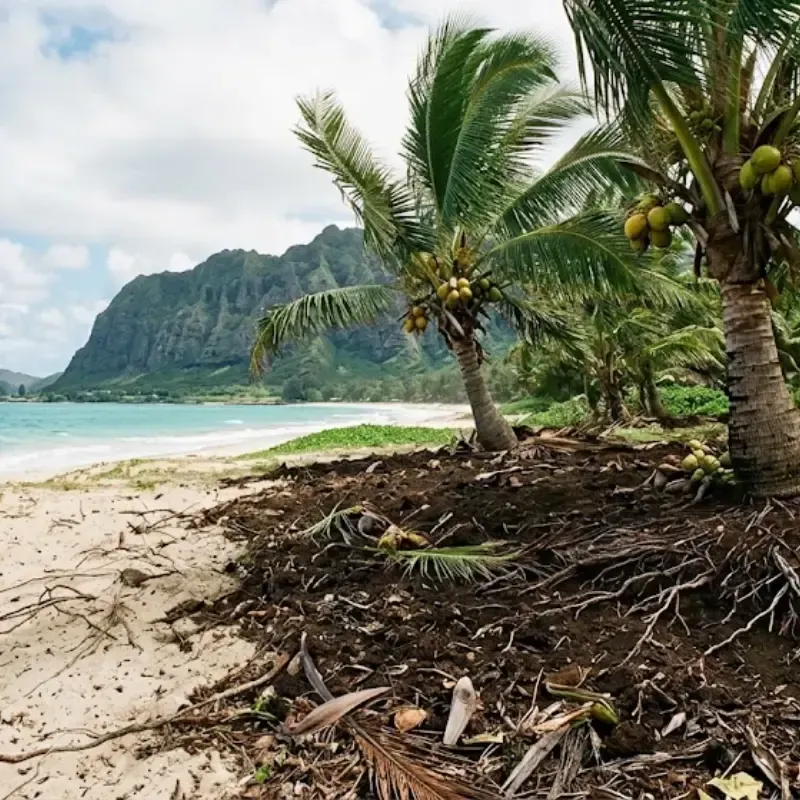
In coastal communities, sandy soils allow excellent drainage, which reduces the risk of standing water and root rot. The downside is that these soils struggle to hold nutrients long enough for roots to absorb them. On the windward side, frequent rain can wash soluble nutrients below feeder roots faster than many fertilization schedules can replace them.
Clay Soils and Compaction Stress
In inland valleys and clay-heavy areas like Mānoa or the Pali corridor, the opposite problem occurs. Nutrients may remain present in the soil longer, but compaction reduces oxygen flow and slows root activity. This means the palm may still struggle even when nutrients are technically available.
Soil pH and Chemical Availability
Soil pH adds another layer. Even when nutrients are present, the wrong pH range can make them chemically unavailable to the palm. This is why some properties report regular fertilization with little visible improvement. Adjusting pH before applying any fertilizer program is often the first corrective step that makes a measurable difference.
Root Health Is the Real Longevity Factor
Coconut palms rely on shallow, fibrous root systems rather than deep taproots. This makes them highly sensitive to disturbances near the surface. Repeated foot traffic, lawn equipment, nearby construction, hardscape installation, or grading work can all compact the soil around the root zone. Once compaction sets in, oxygen drops, water movement changes, and nutrient transport slows.
The palm responds gradually. New fronds emerge smaller, the crown begins to thin, and older fronds decline faster than normal. What many property owners assume is simple age-related decline is often root-zone stress that can still be reversed with early intervention.
At Oahu Tree Trimming and Removal Experts, we regularly encounter palms growing in compacted lawn areas across neighborhoods like Kailua and ʻAāina Haina where mowing and irrigation have significantly altered the surface soil structure. These palms often show potassium and magnesium symptoms regardless of how much product has been applied at the surface, because the real problem is root-zone access, not fertilizer quantity.
Practical Recovery Methods
Mulch application, root-zone aeration, irrigation correction, and properly timed palm fertilization all help restore feeder root performance. In many cases, these adjustments produce significant improvements in frond quality and overall tree stability within a single growing cycle.
Nutrient Deficiency vs Disease: A Common Misdiagnosis
One of the most common mistakes in coconut palm care is confusing nutrient deficiency with disease. Yellowing fronds, browning tips, and thinning crowns can all resemble fungal decline or infection. But treating a nutrient problem like a disease wastes time and often worsens the issue by delaying the correct solution.
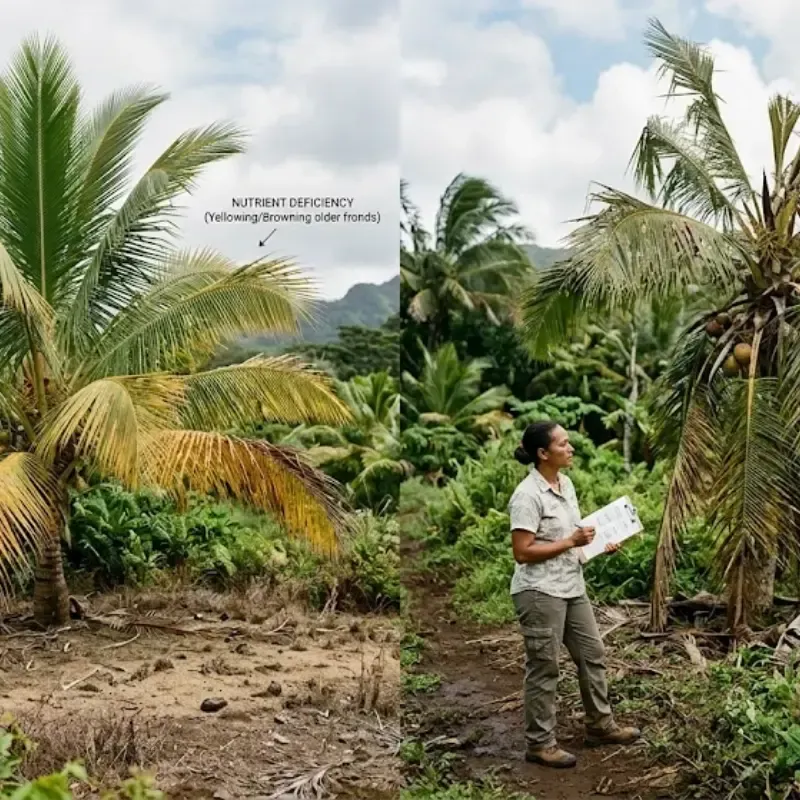
Likewise, aggressive frond removal based on discoloration alone can reduce the palm’s photosynthetic capacity and place even more stress on an already compromised root system. The key difference is that nutrient stress usually follows a pattern tied to older fronds and soil conditions, while disease progression often involves irregular tissue collapse, structural weakness, or visible fungal signs.
If you are unsure whether your palm is experiencing a nutritional issue or something more serious, it helps to understand what fungal disease and crown infections actually look like in Hawaiʻi’s climate before making any pruning or treatment decisions.
Fertilization Timing for Oahu’s Climate
Because coconut palms grow year-round in Hawaiʻi, their nutrient demands remain constant. The best fertilization programs work with Oʿahu’s rainfall patterns rather than against them.
Wet Season Fertilization Strategy
The wet season from October through March is often the best window for slow-release palm fertilizer because rainfall helps carry nutrients gradually into the root zone. Timing matters, however. Applying fertilizer immediately before major storms on slopes or sandy soils can still increase leaching losses significantly.
Windward vs Leeward Scheduling Differences
Windward properties often require shorter fertilizer intervals because rainfall is more frequent. Drier leeward areas such as Ewa Beach can often maintain healthy palms with less frequent applications, provided the soil profile supports nutrient retention.
Palms that receive properly timed, palm-specific fertilizers tend to hold their structural integrity far better during high-wind periods. Reducing coconut fruit drop risks is also closely tied to maintaining consistent nutritional health throughout the year, since stressed palms shed fruit prematurely at much higher rates than well-nourished ones.
Soil Health as a Structural Safety Issue
Healthy soil is directly tied to storm resilience. A coconut palm with nutrient stress and weakened roots is far more likely to lean, uproot, or lose crown mass during seasonal wind events. This becomes even more important in saline coastal soils where salt exposure compounds magnesium loss and root stress. These are often the palms that appear visually stable until a manageable storm reveals the underlying weakness.
University of Hawaiʻi palm nutrition research through the College of Tropical Agriculture and Human Resources consistently identifies potassium and magnesium as the nutrients most associated with structural palm failure under wind stress in island environments. Long-term soil conditioning is not just cosmetic maintenance. It directly contributes to anchorage strength and the overall structural safety of the tree.
What a Professional Assessment Covers
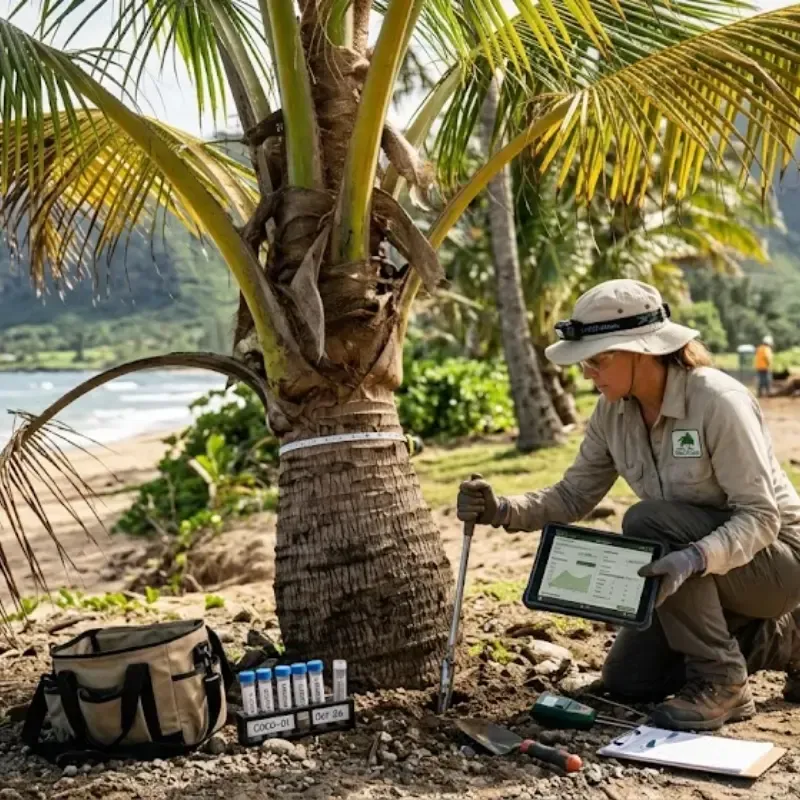
A proper coconut palm assessment should go beyond visual symptoms alone. Frond color and deficiency patterns, crown density and growth rate, soil texture and drainage, irrigation behavior, nearby construction influence, root-zone compaction, possible fungal progression, and soil test confirmation all factor into an accurate diagnosis.
This process allows the real cause of decline to be identified before unnecessary pruning or removal decisions are made. In our work across Oʿahu, the most common outcome of a thorough assessment is discovering that the palm was being treated for the wrong problem entirely.
If your coconut palm shows persistent yellowing, slow frond replacement, thinning crown, or fronds that brown from the tips inward, those symptoms deserve evaluation, not removal. Removing symptomatic fronds without addressing the underlying soil issue leaves the tree in the same deteriorating condition.
Start With the Soil, Not the Symptoms
Coconut palm longevity on Oahu is largely determined below the surface. Soil structure, nutrient retention, pH balance, and root-zone health all directly influence how long a palm remains safe, stable, and visually healthy.
If your palm is thinning, yellowing, or declining despite routine maintenance, the issue may not be weather at all. In many cases, a professional soil and root-zone assessment reveal the real cause before the damage becomes irreversible.
Contact Oahu Tree Trimming for a professional coconut palm evaluation tailored to your property’s specific soil and environmental conditions across Oahu.

Written By:
Domenique Bomediano
Landscape & Tree Care Educational Content Writer
Domenique Jose Bomediano creates research-based content focused on tree care, landscape management, and environmental property concerns. By combining arborist-backed practices, regional considerations, and practical homeowner needs, he helps readers better understand how to maintain safer, healthier outdoor spaces.